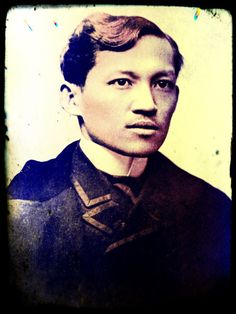
is a Maharlikan? This article is the first attempt to uncover the hidden persona of the great hero Jose Rizal and why he is revered more than a hero.
Rizalistas, a collective term for all the socio-civic or religious organizations adhering to the principles, virtues and teachings of the great Filipino hero Dr. Jose P. Rizal. Generally, the Rizalistas immortalized and worshiped Rizal as a divine being. They regarded him as the re-incarnation of Lord Jesus Christ, the son of Bathala, a spirit, an avatar, a saint, a prophet, while others believe that he is a god and a man at the same time.
[1] These groups acknowledged the hidden divinity in him and worshiped him as such, like the 12 disciples who worshiped their Master Jesus Christ, in the olden days who promised to return in the designated time. The Rizalistas believed that Rizal is the fulfillment of the promise of the Master Jesus.
Some of the registered Rizalista groups are the Samahan ng Tatlong Persona Solo Dios, Ciudad Mistica de Dios, Adamista, Bathalismo, Watawat ng Lahi, Iglesia Sagrada Flilipina, and Espiritual Pilipino Catholic Church, among others. They are scattered all over the Philippine archipelago but most of them are based in Calamba, Laguna and at the foot of Mt. Banahaw in Quezon Province. They have also chapters abroad.
[2] These Rizalista groups venerate Rizal for his apparent parallelism with Jesus Christ. Some of their striking commonalities, according to A.B. Valeriano, are as follows:
[3]
- Both were morally upright and exemplary in their own rights.
- Both were pious.
- Both were Asians.
- Both of them originated from countries which were under foreign rule during their time.
- Both were advocates of solidarity, equality and peaceful coexistence in spite of differences in social status, ethnicity and creed.
- Both possess extraordinary character and have the purest intention in pursuing their missions.
- Both of them were healers.
- Both were great visionaries.
- Both were advocates of reform and peaceful means to carry out their missions.
- Both strongly denounced prejudice, apathy, immorality and cruelty.
- Both were messianic in their own rights.
- Both were victims of trial by mockery.
- Both were executed by their enemies.
- Both died for a noble cause.
- Both their teachings have enduring influence to many people around the world.
The following are excerpts from the prayers of the members of Bathalismo (Inang Mahiwaga, Inc.):
[4]
“Receive, Oh God, the sacrifice which we are offering to Your Majesty,
in honor of Our Father Rizal, the Christ of the Tagalog region.”
…Rizal is the Christ of the Tagalog region.
He is the Lord of the whole world.
He is the King of Kings, the Lord of Lords.
Because in Him is given by the Holy Bible the Spirit of God Almighty.”
But who is Jose Rizal by the name? His complete name is Jose
Protacio Rizal
Mercado y Alonso Realonda. The name Jose is of various origins: For instance,
Jose or
Joseph is the Hebrew name for
Yosef which was a derivative from the Egyptian name
Yousif. Notice the interchangeability of the letters
J and
Y. In the Hebrew alphabet, the letter
Yod (Y), which is their 10th letter, is a sacred letter for them because it gives the meaning
God. Again, this letter
Yod is also transpositionally equivalent to
J and
Y, respectively. So,
Joseph is the same as
Yoseph. This fact also proves that IO is a variation of AO. In Chaldean Numerology AO = IO = 1+7 = 8. Therefore, by implication AO = IO =
Jo =
Yo =
God. The Egyptian suffix
seph means
prince. Therefore,
Yosef which is also
Ioseph means the
Prince of God.
[5]
The name
Jose is also another form of
jove which may mean love, or also refers to
Jupiter (Jove) in Roman mythology, who was the king of the gods and the god of sky and thunder. Jupiter is the equivalent of Zeus in Greek mythology. Jove is also linked to Jehovah, a form of the Hebrew name of God used in the translations of the Bible. This name appeared in Alexander Pope’s The Universal Prayer, which goes:
[6]
Father of all! In every age,
In every clime adored,
By saint, by savage, and by sage,
Jehovah, Jove, or Lord!
Jove also appeared in the Masonic Song
[7] which is sung to the tune of
“God Save the Queen”. A performance of this song in New York City was reported in Gaine’s Mercury, July 2, 1781. The first stanza is herein provided below:
By sacred influence hurl’d,
From chaos rose the world,
Great will of Jove.
Grand architect supreme,
Fountains of wisdom stream,
Receive our humble theme,
Duty and love.
Now, let us examine the name Rizal. Rizal is a combination form of
rex and
al or
el.
Rex in Latin means
king, and
al in the Arabic language could mean either
from or
son.
El for the Hebrews means
god. Thus, the name Jose Rizal could mean
"son of the king" or could simply mean
"the son of god".
So, there you have it. The name Jose Rizal is really something worthy of reverence. Moreover, historical records confirmed that Dr. Jose Rizal was a genius, a martyr and a cosmopolitan man. He carried no specific nationality but instilled the love of one’s country and the love of fellowmen regardless of race or religion. He was regarded by many as the Asia’s First Apostle of Nationalism whose idealism of nationalism inspired many Asian countries to fight for their independence. Rizal was the Filipino messiah who offered his life for the salvation of his people from the bondage of slavery and tyranny by the Spanish authority. For the Filipinos, Dr. Jose Rizal is the true symbolism of hope and the realization of the promise of freedom.